Acknowledging my Nigerian-spiced blood, an empathic woman’s understanding, and a journalistic perspective, I source this piece to a place of heightened cultural sensitivity within me. In that place, I found the courage to walk the fine line between reportorial objectivity and humane consciousness.
* * *
The myriad of socioeconomic problems in Nigeria, compounded by historic political corruption and mismanagement of resources, has made way for a society that largely looks away from the growing problem of internal and international trafficking of prostitutes. It has made for a society where fathers celebrate with money sent to them by daughters prostituting in the likes of Belgium, Morocco, and Germany. A class of people in Nigeria has resorted to defending the prostitution trade when the plate of dignity-stripping poverty is on the table, when school fees need to be paid, when one desires access to the country’s billionaire “one percent-ers,” when a job promotion is on the line, when mothers have laid malnourished children into tiny earthen graves.
Prostitution, allegedly the world’s oldest profession, operates on a massive scale in Nigeria, where traffickers promise young girls a life of good fortune in Europe and the girls, vulnerable and frustrated with the instability of life in their homeland, follow these nameless go-betweens to faraway lands. The girls sometimes never return.
But, like life itself, the story of the Nigerian prostitute has a beginning.
Nigeria’s poverty dilemma
From villages where the thick dark of twilight descends upon one-roomed homes of corrugated tin rooftops; to cosmopolitan locales, like Lagos and Onitsha, where slender long-legged ladies prance on rainbow-colored stilettos; to towns full of uniformed school children and hardworking civil servants wearing sharply pressed collared shirts, women and girls are being trafficked, sold, kidnapped, and lured into prostitution.
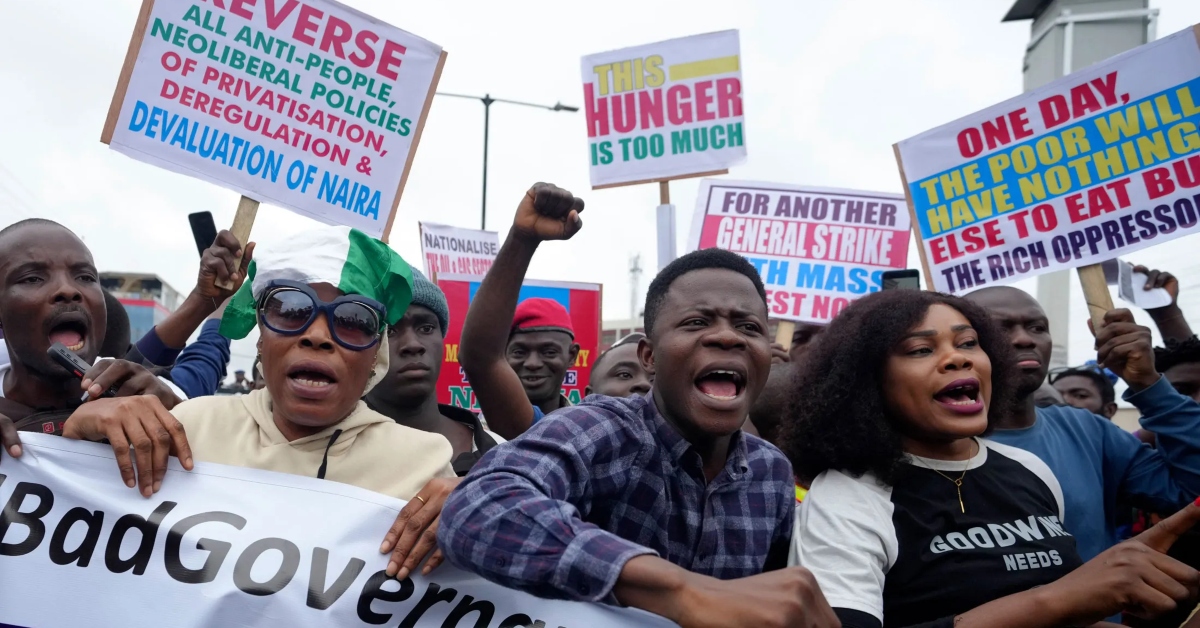
They come in diverse shapes and sizes, these females, with names like Jumoke and Onazotsena and Ekaete and Chigozie. Their families, usually among the nearly 60 percent in the population who live on less than one dollar a day, struggle to make ends meet. The bare-boned irony is that Nigeria, suffering from the so-called “curse of black gold,” remains the largest crude oil producer in Africa (Angola, Libya, and Algeria are not far behind). More than USD $600 billion in oil revenues have flowed into Nigeria since its independence in 1960, accounting for about 90 percent of the country’s export earnings. Of that $600 billion, the World Bank reports that $300 billion has been stolen and stored in foreign bank accounts.
But those billions have not trickled down to the majority of the 160 million people who call Nigeria home.
So under the crushing weight of poverty, families often use their children to raise supplemental income and prostitution has become a readily taken path.
Recruiters of sex workers fabricate stories of a fantastic life in Europe to naïve girls who simply want money to go to school, to women who believe their dreams of a better life may be actualized outside of the country’s borders, to anyone frustrated with the seeming hopelessness of the life of the poor in Nigeria.
The trafficking of persons is the third largest crime in Nigeria after economic fraud and the drug trade according to UNESCO, and while some victims remain in Nigeria or in neighboring countries, thousands eventually end up in Italy, Greece, the Netherlands, Turkey, Belgium, Sweden, Spain, Denmark, Norway, Ireland, England, Russia, and increasingly in South America.
The United Nations estimates that 10,000 Nigerian girls are prostituting just in Italy alone, where most of them are managed by a Nigerian mafia-styled criminal network.
Trafficked girls often tell a story of brutality and violence and in Italy, more than 600 Nigerian girls were killed, according to a research conducted by the Association of Benin City Girls.
A hellish journey
The road to Europe is a circuitous one.
Several advocacy organizations and many Nigerians on ground assert that for most girls trafficked into prostitution, the journey began in Benin City—the historic capital city of Edo State in southern Nigeria.
It is in Benin City where traffickers, representing small-scale operations and even multinational networks recruit the most vulnerable girls and women who often come from rural areas. From Benin City, they may travel to cities within Nigeria including Ibadan, Calabar, Lagos, and Kano.
But the goal is to get the girls into Europe. That means crossing the Sahara Desert or tackling the waters of the Atlantic Ocean, as reports show that more traffickers are utilizing land and sea routes to avoid costly air travel.
Unfortunately, thousands of girls do not survive the journey, their young lives snatched away by starvation, dehydration, malaria, fever, exhaustion, physical trauma and illness or drowning.
If they do survive, they may stop in Morocco, Libya, Egypt, and Mali to wait as captives in transit. The United Nations Refugee Agency reported that in September 2010, senior officials from Nigeria’s National Agency for the Prohibition of Trafficking in Persons (NAPTIP) traveled to Mali where 20,000 to 40,000 Nigerian women were reportedly living in forced prostitution.
Upon arriving in Europe, the girls learn they must pay a “debt” to earn their freedom, an average of 80,000 euros, which is more than $105,000 USD. It becomes a never-ending venture: paying a debt that can never really be paid, as girls are expected to support themselves with food and clothing.
This is the misfortune that hundreds and thousands of Nigerian girls have fallen victim to and NAPTIP, the under-funded anti-trafficking agency just cannot seem curb the plague.
A cultural celebration of women
I cannot help but think of the Nigerian cultural values that place high esteem on womanhood. I was raised to believe that womanhood is to be celebrated, and while scholars and so-called experts assert that Nigeria is a male-dominated society, many Nigerians hail strong, intelligent woman. The beauty and grace of the Nigerian woman is personified in the likes of Grace Soyinka, Kudirat Abiola, Chimamanda Adichie, Diana Wiwa, and Funmilayo Ransome Kuti.
Having never reached my goal to grace 5-foot-10 inches, being that vertical endowment is such a highly favored trait among Nigerians, I grew up in the shadow of elongated Nigerian women, admiring their shiny bracelets, bangles, and the one-too many necklaces and gold-plated anklets, lingering in their perfumes. Dressing before mirrors in bathrooms, I’ve conjured mental images of women with names like Nkiru, Busola, and Sinani. Every new school year, I proudly announced my Nigerian heritage, waiting for the “oohs” and “aahs” of my classmates, and always surprised when I didn’t hear any.
The Nigerian woman has an enduring magnetism. She’s the ultimate fashionista, swathed in yards and yards of Austrian lace, sparkling handmade georgettes and bedazzled cotton ankaras.
But what can be done to preserve the honor of Nigerian women and girls when thousands of them bear the shame of prostitution?
While writing this, I sought to find a proverb from my native ethnic group (the Igbo people of Nigeria) to convey the matter at hand. My mother gave me this one: “Ukwu n’aga warawara anya n’aga warawara n’ahu ya.” This Igbo aphorism literally says “the leg that walks fast is being noticed by the eyes that see fast.” It means that whatever is hidden will eventually be exposed.
The mind-blowing magnitude of sex trafficking in Nigeria has been exposed as the fate of many Nigerian girls all over the world lies in the hands of pimps.
In this day and age, we have the power to stop this.
We need to use our mouths and our voices, our pens and our minds, our Tweets and our Facebook walls to campaign against the rampant infestation of sex trafficking in Nigeria.
I ask my fellow Nigerians: Why are we standing back and allowing our ladies to self-destruct and be destructed? She is your comforter, your secret-keeper, your mother, your confidante, your sister. She bandaged your knee when you fell from running too fast and she was there in the store with you when you tried on your first mini-skirt. You both vowed to get married after secondary school. She’s the one you envied because all the guys wanted to date her.
She, and all the others, need advocates to speak for her.
Our Nigerian she-roes
My grandmother, an energetic septuagenarian, comes to mind.
With stubbornly white teeth and bark-colored skin, my grandmother still walks to the market near her home in southeast Nigeria. She still asks her husband what he desires to eat, still bends over in the light of dawn with her bosoms greeting the rust-colored earth as she sweeps. And with each sweep of the broom, I’d like to think she’s thinking about her life, past, present and what’s yet to come. And the daughters and granddaughters she has held with her solid hands grew so fast. Some of them like myself have traveled across the ocean.
I have her to look up to. I implore my fellow Nigerian women to remember their strong matriarchs and girlfriends and aunties. We all have women to look up to. Ours is a culture that places high esteem on womanhood. We can’t lose continue losing our women and girls to prostitution.


RSS