africa

Search Africa.com

Africa.com Blog

twitter facebook Africa.com's RSS Feed
Arts & Culture
Wednesday, September 29, 2010

Carpaccio: A Thin Slice of South Africa

by R. Steven LewisI approached our trip with a sense of urgency to dig beneath the surface rhetoric and the seduction of “truth and reconciliation” to uncover the true conditions under which the country is moving forward. Given the relative brevity of our visit, I will not pretend to have acquired an in depth understanding of the many factors - both past and present - that have contributed to the spatial consequences of apartheid, and the country’s apparent confusion surrounding attempts to recover from it. However, as Malcolm Gladwell posits in his latest book, “Blink,” we were able to glean at a glance enough evidence to indicate that either insufficient or inadequate planning on the part of South African authorities is resulting in the rapid creation of new communities that embody what most planners and design professionals from the western world would consider the worst approaches to development. 

I was disturbed most by what we observed to be South Africa's housing production and delivery policy aimed at transitioning the multitude of poor Black Africans out of the squalid conditions of the informal settlements that have become emblematic, and into new government-provided housing. Cobbled together with found materials and devoid of running water except for the communal taps and occasional groupings of porta-potties sprawled across the landscape, these developments formed a visual tapestry that I admit reluctantly to admiring. The tragic beauty embodied in the collage of materials was aptly characterized by a close friend, Paul Harris, as being “dividends of oppression.” The irrepressible human spirit of the residents who inhabit these dark places refuses to be suppressed and shines through the darkness to provide a ray of hope that life in post-apartheid South Africa will be better. This hope is especially apparent in the eyes of the children, whose innocence is that of all children. The question remains as to how the government and those with privilege will honor the right of poor Black Africans to be treated justly and with dignity as they emerge from the shadows of the past to take their rightful place at the helm of business, government and society. 

Solving the housing problem appeared to us to be one of, if not the top priority of the government, although it is unclear whether the motivation is social justice or putting on a good face for those who would visit during the 2010 World Cup. The country is under tremendous pressure to deliver new Government-provided housing units, complete with internal plumbing. Unfortunately, the government appears to be using a "ready, fire, aim..." approach with regard to development, thereby rendering the efforts of even the most talented architects and planners null and void. No one seems to be taking the time, or more accurately, to possess the time to think and to plan in a sustainable manner. Instead, driven solely by a mandate to build, build, build, they continue to sprawl, sprawl, sprawl! Not a pretty picture. With continuing sprawl, large numbers of poor Black Africans are being pushed farther out from urban employment centers. With no organized mass transit system other than the informal combie taxis, people suffer, as does the environment.

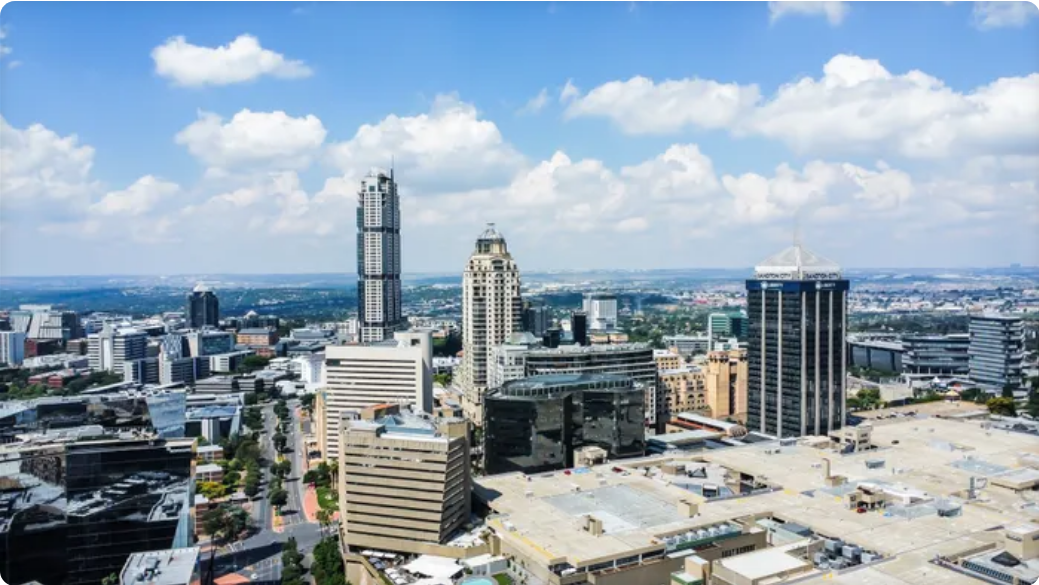
Furthermore, residents who do not possess the means to receive and pay a monthly bill, who live in both new and existing government housing units, receive a 6,000 liter water allocation per month, complete with a meter that requires prepayment to enable it. But oops, they put toilets in these homes. Hum...how many liters per flush? Whoops, there goes our monthly allocation – that is, if we chose to flush. The myriad of problems surrounding how the government might satisfy the constitutional mandate to provide all of its citizens with housing and water equates to a series of complex challenges confronting those in power that have been charged with uplifting the masses. So we continued our travels around meeting with key agencies, organizations and individuals, and along the way realized that Johannesburg was familiar as a city, and yet still different somehow. The apparent dominance of the Black African population was evident in the sheer number of people we saw everywhere, from the City center to the outlying townships. And yet, as we met with organization after agency, after group, we consistently saw clear evidence that the White minority still occupy the majority of positions of power and authority. It is clear that until the Government makes education its number one priority, there will be a deficit in capacity and capability among the Black South African population, thereby keeping the assumption of control and authority out of reach for the foreseeable future. 

Notwithstanding the prevailing social conditions, I made it a point to go in search of Black African architects who might be playing a role in shaping the built environment, either in preparation for the 2010 World Cup, or in satisfying the government's ridiculous mandate to provide a gazillion housing units in too short a timeframe. Black African architects, it seemed, were as invisible as ever within the paradigm of power (ie: either the ‘Old Whites’ or the ‘New Blacks’). I did, however, manage to connect with a few who are working on significant projects - Mphethi Morojele of MMA Architects, shared with excitement several school projects that the firm is executing in Khayalitsha Township1 outside of Cape Town. Another architect, Selby Shiba was busy at work on a Saturday when I showed up on his doorstep, designing an elevated railway station sited in a prominent area of the city. But compared to the predominantly White South African designers and firms who are capturing the legacy of this historic time within their country in the form of major civic commissions, such as the Apartheid Museum2 and the Constitutional Court, the expressive voice of the majority culture is substantially absent from the “conversation” that is taking place in the built landscape.

By taking Gladwell’s approach and “thin-slicing” South Africa in the brief time we spent there, it shares with America a high-minded notion that is perhaps best expressed through the legacy of Senator Daniel Patrick Moynihan, who challenged us to create civic architecture that embodies the values and ideals of our society in such a way that when future generations seek to understand who we were, they need only look back at the buildings we left behind. Since people of color are the victims of oppression in both places, it is my hope that architects, designers and planners of color will step forward to participate in, and contribute to the built histories that will be constructed of both places, and that our societies will understand the importance and value of such diversity and embrace those who will bring it about.
 
1 It so happens that I am currently designing a community center in Khayalitsha along with a team of eight students from the Harvard Graduate School of Design whom I enlisted during my Loeb Fellowship year. Five of the students sought and received travel grants and are spending the summer over there moving the project forward.

2 The Apartheid Museum was designed by the firm of Marshabane and Rose. Phill Marshabane is a Black South African; however, his partner, Jeremy Rose is the designer (extroadinary) within the firm. Phill focuses on business development and preservation work within the office. R. Steven Lewis is an architect with Pasadena-based Parsons Corporation, who also serves as the current president of the National Organization of Minority Architects. Also an avid photographer, he traveled to South Africa during his year as a Harvard Loeb Fellow in 2007, and recorded many facets of a complex society in the midst of reinventing itself.


R. Steven Lewis is an architect with Pasadena-based Parsons Corporation, who also serves as the current president of the National Organization of Minority Architects. Also an avid photographer, he traveled to South Africa during his year as a Harvard Loeb Fellow in 2007, and recorded many facets of a complex society in the midst of reinventing itself.


‹ Go Back to Main Blog Page
BLOG CATEGORIES
BLOG ARCHIVE


Sign up and tell us if you agree with the author's point of view. Don't have an account? Register for free!


africa

Contact Us | Privacy Policy | Terms of Service | Digital Millennium Copyright Act | Newsletter Africa.com Newsletter | RSS Feed Africa.com RSS | Advertise With Us

Copyright © Africa.com 2012. All Rights Reserved.